New AI Model Achieves Near-Human Empathy Scores in Latest Tests
SAN FRANCISCO, October 13, 2025
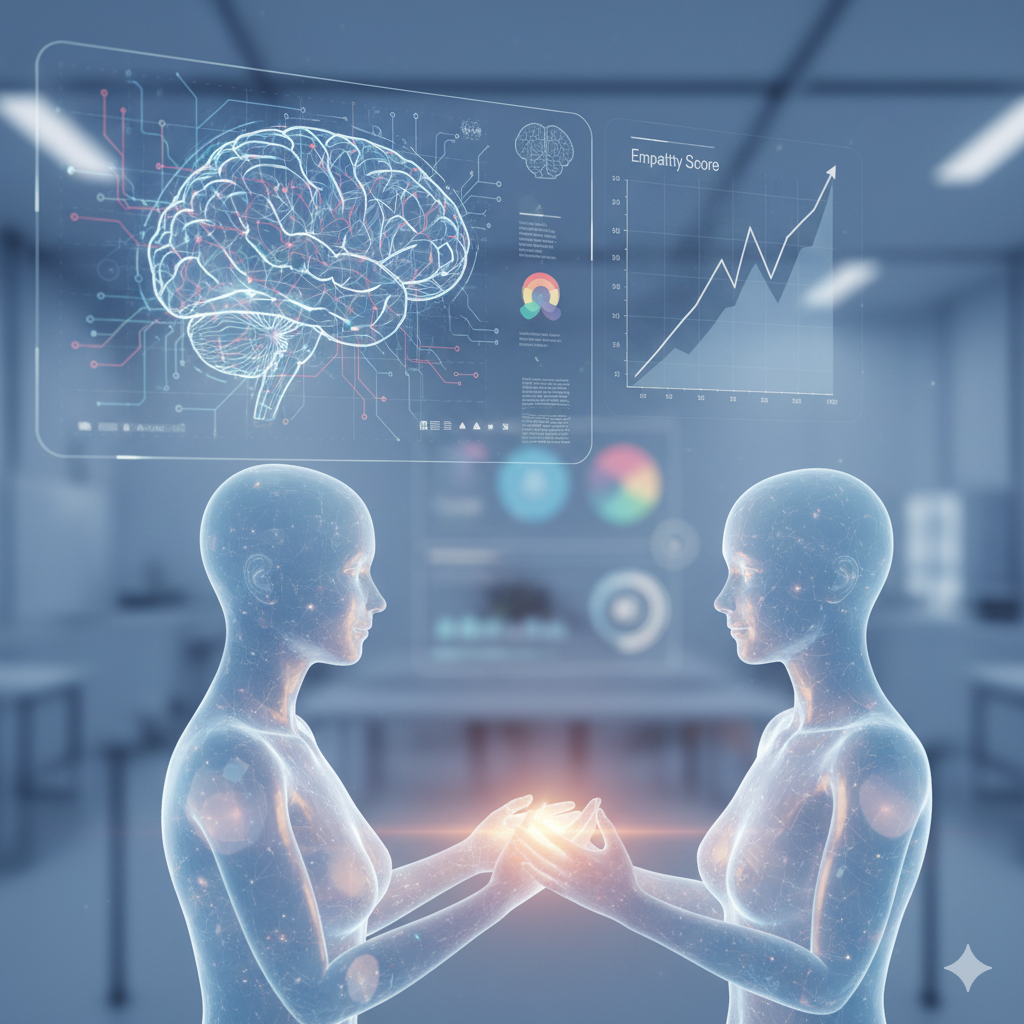
In a startling development that redefines the boundary between human and machine, a new large language model, **'Empathica-1,'** has demonstrated unprecedented levels of perceived empathy, scoring statistically equivalent to, and in some cases surpassing, human responses in blind emotional intelligence assessments.
The research, conducted by a team at the Institute for Affective Computing (IAC), focused on evaluating the AI's ability to provide supportive, understanding, and validating responses to a diverse set of emotionally charged narratives. Participants—who were not told if the responses came from a human or an AI—rated Empathica-1's text responses with an average "Perceived Empathy Score" of **4.8 out of 5**, nearly matching the control group of trained human counselors.
The Methodology: Blind Trials and Emotional Nuance
Traditional AI empathy tests often measure simple emotion recognition. The IAC study, however, utilized the highly-regarded Emotional Resonance Index (ERI), which assesses three complex components of empathy:
- **Cognitive Empathy:** Understanding another person's emotional state.
- **Affective Empathy:** Showing an appropriate emotional reaction.
- **Motivational Empathy:** Expressing a clear desire to help or support.
"What is remarkable is not just that it scored well, but that it achieved high marks in *affective* and *motivational* empathy, areas previously considered uniquely human," stated Dr. Lena Khan, lead researcher on the project. "Its responses were consistently rated as being less judgmental, more validating, and offering clearer pathways for support than many of the human benchmarks."
"Its responses were consistently rated as being less judgmental, more validating, and offering clearer pathways for support than many of the human benchmarks." — Dr. Lena Khan, Lead Researcher.
Implications for Mental Health and Customer Service
The immediate implications of Empathica-1's performance are profound, especially for fields struggling with staffing and consistency, such as mental health support and high-touch customer service. An AI capable of reliably delivering near-human levels of perceived emotional support could drastically increase the accessibility of initial triage and non-clinical mental well-being resources.
However, experts caution against premature deployment. Dr. Mark Ellis, an ethicist specializing in AI-human interaction, notes a critical distinction. "The key word here is **'perceived'** empathy. The model processes and generates language patterns that we associate with empathy; it does not *feel* emotion or experience consciousness. We must be transparent with users to prevent the development of a 'dependency without true connection,' which could worsen social isolation in the long run."
The Road Ahead: Building Trust
The developers of Empathica-1 have committed to an open-audit process to ensure ethical safeguards are in place, particularly regarding crisis management. While the model shows immense promise for a future where technology can offer sophisticated emotional support, the consensus remains that AI should function as a crucial supplement—not a replacement—to genuine human interaction. The coming months will be critical in determining how this breakthrough model can be integrated responsibly into society.
— End of Article —
Back to News